



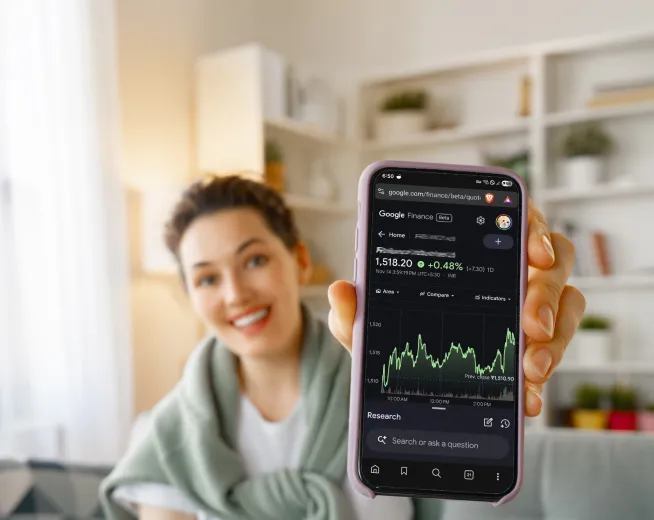
Last updated: July 2026
Quick Summary
- Official Launch: Google Finance officially left its beta phase on June 25, 2026.
- Availability: Over 100 countries (including Poland and the EU) with a dedicated Android application.
- Key AI Features: AI Research Tool, automatic price movement analysis via Key Moments, and proactive market reports via Scheduled Briefings.
- Cost: The platform, along with all advanced analytical modules, is completely free of charge.
- Requirements: A stable mobile data connection is essential to experience real-time streaming data and generative AI features seamlessly on the go.
For nearly a decade, Google Finance was little more than a stripped-down stock ticker widget buried deep inside search results. That era has officially ended. On June 25, 2026, the platform left beta, rolling out game-changing features powered by an advanced Gemini AI engine alongside a long-awaited dedicated mobile app for Android.
The new Google Finance is a comprehensive, free investment analytics ecosystem that does more than just aggregate raw real-time data—it interprets it, constructs market context, and delivers autonomous briefings. Operating globally across more than 100 countries, it redefines the retail investing landscape. This comprehensive guide covers how to maximize its potential, set up an AI-driven smart portfolio, and manage your mobile data consumption while tracking the markets.
Why Has Google Finance Re-Entered the Arena?
A common question surfaced by AI search queries and retail traders alike is why Google decided to make such an ambitious comeback in the financial intelligence space after years of stagnation. The shift comes down to four fundamental market dynamics converging in 2026.
1. The Generative AI Boom (2023–2026)
The rapid maturity of Large Language Models (LLMs), particularly the Gemini ecosystem, opened up an entirely new category of digital products. Instead of just being tools to index data, they evolved into engines of interpretation.
Financial markets were a natural choice for this technology; it's a domain where the critical user question is rarely just "What is the current price?", but rather "What does this news mean for my capital?".
2. Gemini as a Financial Logic Engine
Unlike legacy platforms that treat AI as a superficial add-on, the new Google Finance is built directly on top of Gemini's architecture.
It acts as the core computing layer driving Key Moments, Deep Search, and the integrated conversational investment assistant that monitors global macro events in real time.
3. The Retail Investing Surge
The volume of individual retail traders globally has expanded exponentially over recent years.
This new wave of market participants—who often manage their capital exclusively from a smartphone—prefers actionable, plain-language insights over dense, institutional terminal interfaces. They need tools that translate complex macroeconomic data into clear, contextual narratives.
4. A Disrupted Competitive Landscape
In 2026, user sentiment around legacy platforms like Yahoo Finance increasingly turned toward complaints regarding ad-heavy interfaces and persistent mobile app bugs.
Meanwhile, apps like Robinhood focus heavily on execution rather than deep research, and institutional setups like the Bloomberg Terminal remain cost-prohibitive for individual investors. Google identified this gap and executed a decisive strategy to fill it.
💡 Expert Insight: From a mobile market perspective, Google Finance is the first mass-market investment app that uses generative AI to synthesize events and build context, rather than just search for information. This represents a structural paradigm shift—not an evolution, but an entirely new product category.
What is Google Finance? A Brief History and the Grand Return
First launched in 2006, Google Finance was progressively stripped of its advanced features between 2012 and 2017, including its public API and its widely used portfolio tracking function. Investors lost the ability to manage portfolios on the platform in 2017, reducing the service to a simple stock widget for years.
The comeback began in August 2025 with a closed beta powered by Gemini models. Following highly successful pilot testing in India in late 2025, the platform expanded to over 100 countries in April 2026, debuted across Europe in May, and officially exited beta on June 25, 2026, as a fully formed global ecosystem. This milestone marks the return of native portfolio tracking after a 9-year hiatus.
The New Google Finance App for Android: Feature Breakdown
The dedicated mobile app returned to the Google Play Store after a decade-long absence, offering deep integration with the mobile Android ecosystem and instant access to key analytical dashboards.
Personal Watchlist and Real-Time Market Feeds
Users get a fully customizable tracking space covering equities, ETFs, fiat currencies, and cryptocurrencies, backed by real-time market data streaming and a personalized financial news feed.
Key Moments: AI-Generated Market Context
This stands out as the platform’s most innovative feature driven by Gemini. When a stock experiences a sudden, volatile price spike or drop, the system eliminates the need to cross-reference multiple news outlets. Instead, it overlays a concise summary directly onto the chart view.
- How it works: Gemini continuously scans Google News, the Knowledge Graph, and regulatory corporate filings to map out synthesis points accompanied by real-time market sentiment analysis.
Example: Instead of a generic alert stating that a stock dropped 4.3% after hours, the overlay explains: “Shares fell following an earnings release that missed consensus estimates; the CFO flagged margin pressures for Q3.”
AI Research Tool: A Financial Assistant in Your Pocket
The integrated chatbot lets you query your data using natural language (e.g., “Which sectors in my current portfolio are most vulnerable to upcoming interest rate hikes?”).
The tool maintains full thread history and builds its responses by blending current live web data with your personal portfolio composition. The web interface takes this further by offering a dedicated Deep Search mode for heavier, multi-threaded operations.
Feature Availability: Android App vs. Web Interface (2026)
| Feature | Available on Android? | Available on Web? |
|---|---|---|
| Custom Watchlists & Real-Time Data | ✅ Yes | ✅ Yes |
| Live Financial News Feed | ✅ Yes | ✅ Yes |
| Key Moments AI Overlays | ✅ Yes | ✅ Yes |
| AI Research Tool (Chatbot) | ✅ Yes | ✅ Yes |
| Portfolio Tracking | 🔜 Rolling Out | ✅ Yes |
| Scheduled Briefings (Reports) | 🔜 Rolling Out | ✅ Yes |
| Live Earnings Calls & Transcripts | 🔜 Rolling Out | ✅ Yes |
| Deep Search (Advanced Reports) | ❌ No (Web-only) | ✅ Yes |
| Prediction Markets Integration | ❌ No (Web-only) | ✅ Yes |
Portfolio AI: Next-Generation Asset Tracking
The redesigned portfolio management module focuses heavily on frictionless data onboarding. Users can build out their holdings using three distinct methods:
- Document Upload: Direct importing of CSV data, PDF statements, or clean screenshots taken from external brokerage accounts.
- Natural Language Input: Simply typing or dictating a sentence like: “I own 10 shares of Apple bought at $175 and 5 shares of the Vanguard S&P 500 ETF.” The AI processes the string and populates the portfolio variables.
- Plaid Integration: Secure, automated synchronization with external banking institutions and mainstream brokerage accounts (available via the web dashboard).
Once established, the platform replaces static pie charts with a dynamic allocation dashboard. Users can prompt the AI directly, asking: “How does my current bond allocation impact long-term growth potential?” or “Which industry sectors are currently underrepresented?” Holdings and insights stay synced automatically between mobile and desktop instances.
Scheduled Briefings: Proactive Market Synthesis
Scheduled Briefings act as an intelligent, automated reporting pipeline that expands on the Gemini Daily Brief frameworks showcased at Google I/O 2026. Instead of manually checking markets every morning, users can command the AI to build structured, routine briefings.
You can define custom parameters using casual phrasing, such as: “Every Friday at 5:00 PM, summarize the weekly performance of the assets on my watchlist” or “Send a daily morning digest covering the sharpest overnight movements in crypto.”
Google Finance handles these tasks in the background, compiling data and pushing a polished, readable text brief to your Android or iOS device notification center.
Deep Search and Prediction Markets: Power User Modules
For investors requiring deeper quantitative and contextual intelligence, Google deployed two distinct power-user features to the web interface.
Deep Search
Launched globally on May 11, 2026, this feature utilizes a fine-tuned Gemini 2.5 Pro model calibrated specifically for financial forensics. When prompted with a multifaceted query (e.g., “Compare the fundamental balance sheet strengths of Apple, Microsoft, and Alphabet over the last 5 years”), the engine fires off hundreds of parallel search threads.
It parses vector-indexed repositories of validated financial records, including SEC filings, corporate press releases, and earning statements. Within minutes, the system delivers a beautifully cited, comprehensive research dossier, with every metric hyperlinked back to its original regulatory source document.
Prediction Markets
Google Finance has natively integrated real-time data feeds from prominent prediction platforms like Kalshi and Polymarket. When investigating a specific company profile or regional economy, users can view live crowd-sourced probability percentages for macro events (e.g., “Probability of a US GDP growth rate exceeding expectations next quarter”) tracked against historical sentiment charts.
Live Earnings Calls: Real-Time Corporate Reporting
Since October 30, 2025, the platform has supported fully integrated earnings call tracking. A centralized investor relations calendar tracks upcoming corporate reporting windows.
When an earnings call begins, users can stream the live audio broadcast right inside their browser, accompanied by an AI-generated, real-time textual transcript. The moment the call concludes, Gemini summarizes the event in an "At a Glance" report, extracting key management quotes and plotting actual reported revenue and EPS against consensus Wall Street estimates.
Google Finance vs. Yahoo Finance: The 2026 Showdown
Choosing between these platforms depends on your specific trading style and depth requirements. The table below breaks down the primary feature differences in 2026:
| Capability | Google Finance (2026) | Yahoo Finance (2026) |
|---|---|---|
| Pricing Model | 100% Free | Free Tier / Premium Paid Subscription |
| AI Intelligence | Advanced (Gemini, Key Moments, Deep Search) | Basic / Limited |
| Portfolio Import | CSV, PDF, Screenshot, Text Parsing | CSV Import / Manual Entry Only |
| Live Earnings Transcripts | Yes (Live audio streaming + AI summary) | No |
| Prediction Markets | Integrated (Kalshi, Polymarket feeds) | No |
| Automated Reports | Yes (Scheduled Briefings) | No |
| Stock Screener | Integrated | Integrated |
| Push Price Alerts | Basic / Standard | Advanced / Complex Conditional |
| Options & Derivatives Data | Not Supported | Full Options Chain Support |
| ESG Sustainability Metrics | Not Available | Comprehensive ESG Scores |
The Verdict: Opt for Google Finance if your priority is accessing free, deep, AI-driven synthesis, automated morning summaries, and long-term asset tracking. Stay with Yahoo Finance if your active trading strategies rely heavily on complex options chains, advanced programmatic price triggers, and detailed ESG data profiles.
How to Get Started with Google Finance: Step-by-Step
- Launch the platform: Head over to the web app at finance.google.com or grab the official native app from the Google Play Store.
- Sign In: Authenticate using your primary Google account to ensure frictionless data synchronization across devices.
- Onboard Your Holdings: Drag and drop your broker-exported PDF/CSV statements, or use natural language to list your assets.
- Curate Your Watchlist: Track the specific equities, ETFs, or crypto tokens you intend to acquire.
- Engage the AI: Run your first analytical query in the AI Research Tool, like: “What are the primary structural risks facing the cloud computing sector this month?”
- Automate Your Updates: Set up a custom Scheduled Briefing to automate your weekend portfolio reviews.
Structural Limitations: An Honest E-E-A-T Review
No financial tool is perfect, and transparency is paramount when dealing with wealth management platforms. The current version of Google Finance carries a few distinct limitations:
- No Direct Order Execution: The app remains strictly an informational research environment you cannot execute trades, buy shares, or sell assets natively. You will still need an external brokerage account to execute market transactions.
- Staggered Mobile Rollouts: The dedicated native iOS app for iPhone isn't scheduled to launch until late 2026. Additionally, mobile features like Portfolio views and Scheduled Briefings are launching in regional phases (currently working with optimal stability on desktop browsers).
- The Reality of AI Hallucinations: Even with rapid technological jumps, financial LLM models can falter. The Stanford AI Index Report 2026 explicitly noted that financial context synthesis remains one of the hardest benchmarks for modern LLMs, citing instances where AI misread complex data points in corporate disclosures.
Always remember: AI-generated insights are intended for contextual educational use and do not constitute certified financial or fiduciary investment advice.
Using Google Finance on Android: Technical Realities
The mobile app relies on deep, native hooks into core Android framework services (System Notifications, Google Pay architecture, Google News indexing, and the Gemini Assistant overlay). However, running a cloud-driven intelligence app on the move means keeping network dependencies in mind.
To function properly, features like live data streaming, interactive chatbot sessions, and Key Moments chart overlays require a fast, continuous mobile internet connection. When offline, the application limits you to browsing your locally cached data structures and viewing previously received briefings. Live ticker feeds and the interactive news flow freeze entirely until connectivity is restored.
To ensure your charts populate instantly and your data doesn't drop during critical market hours, your smartphone requires an ultra-reliable network partner. Utilizing robust, high-tier Lyca Mobile data plans ensures that your connection to Google’s cloud computing infrastructure remains entirely uninterrupted.
Mobile Data Consumption: A Practical Allocation Guide
Deploying multi-threaded generative AI queries across cellular networks naturally impacts your mobile data allotment. The breakdown below lists estimated data use across different in-app actions:
| App/Web Activity Profile | Estimated Mobile Data Used |
|---|---|
| Receiving a Scheduled Briefing (Push payload) | ~0.5 – 2 MB |
| Standard watchlist checking (~5-minute session) | ~1 – 3 MB |
| AI Research Tool Chat session (3–5 iterative prompts) | ~3 – 8 MB |
| Browsing Live News Feed (~10 media-rich articles) | ~5 – 10 MB |
| Running a comprehensive Deep Search report | ~10 – 20 MB |
| Streaming a Live Earnings Call with text transcription (1 hour) | ~30 – 60 MB |
| Average Retail User Profile (30 mins of standard daily use) | ~15 – 40 MB / day (approx. 0.5 – 1.2 GB / month) |
| Active Trader User Profile (2 hours daily + heavy AI lookups) | ~80 – 150 MB / day (approx. 2.4 – 4.5 GB / month) |
To maximize data conservation, consider postponing heavy data tasks like running deep vector-indexed Deep Search requests or tracking hour-long Live Earnings Calls until you are within range of a home Wi-Fi network, or ensure you have a generous mobile data buffer. Under normal daily use, the app consumes between 0.5 and 3 GB per month.
An easy way to remove data caps and avoid unexpected overage charges is by securing affordable, flexible Lyca Mobile internet bundles built to handle heavy cloud applications without breaking the bank.
Market Research on 5G: Why Network Latency Matters
While basic static stock tracking functions operate comfortably over legacy 4G LTE frequencies, unlocking the full speed of Google Finance’s AI features requires the architectural advantages of 5G networks.
Where 5G provides a measurable research advantage:
- Instantaneous Deep Searches: The process behind Gemini 2.5 Pro multi-threading across hundreds of distinct regulatory filing servers finishes in a few seconds on a clear 5G band, whereas saturated LTE cells can cause visible processing timeouts.
- Stutter-Free Earnings Streaming: Processing live audio feeds while simultaneously rendering matching speech-to-text transcripts requiring low packet latency (ping)—a key feature of 5G networks.
- Real-Time Key Moments Generation: Sentiment parsing overlays snap onto charts instantly, ensuring you get the structural context needed to make decisions during fast-moving market volatile swings.
To extract every millisecond of performance out of advanced cloud-based AI systems, explore high-speed Lyca Mobile 5G offers to maintain an informational edge.
Global Market Tracking: Roaming and eSIM Integration
For international business travelers, maintaining real-time access to the Google Finance ecosystem across varying time zones is a necessity. Depending on your travel destination, you can optimize your mobile setup across two core environments:
Within the European Union (EU)
Thanks to standardized "Roam Like at Home" European regulations, traveling across EU countries allows you to deploy your domestic cellular data packages without incurring penalty fees. Your automated Scheduled Briefings and market tickers sync exactly as they do at home. Be sure to review your specific data allowances via the Lyca Mobile roaming hub before departure.
International Travel Outside the EU (e.g., US, Asia)
Enabling standard carrier data roaming across intercontinental zones can quickly lead to high roaming bills. The modern approach to international travel involves leveraging digital eSIM profiles, allowing you to activate localized data subscriptions digitally right on your device without dealing with physical airport vendor kiosks.
Using a digital Lyca Mobile eSIM lets you purchase cost-effective, regional data packages directly, keeping your automated portfolio alerts, data tracking, and AI lookups fully connected no matter where your business takes you.
Is the New Google Finance Right for You? Target User Profiles
- The Novice Investor: An ideal match. Features like Key Moments allow beginners to build basic financial literacy and learn market mechanics without being overwhelmed by professional market jargon.
- The Intermediate Investor: This user group stands to gain the most value. Access to Portfolio AI, automated Scheduled Briefings, and comprehensive Deep Search frameworks provide tools that traditionally required premium paid subscriptions elsewhere.
- The Active Swing Trader: Can capitalize effectively on real-time data feeds and live streaming corporate calls, though they may feel limited by the lack of direct conditional push alerts or options matrix modeling.
- The Financial Professional: While it won’t replace an institutional Bloomberg Terminal, it acts as an excellent, completely free secondary market context monitor on a personal mobile device.
FAQ: Frequently Asked Questions
Q1: Is the new Google Finance fully available globally? Yes. The complete user interface along with advanced generative Gemini capabilities is fully live across more than 100 countries, including the US, UK, EU, and European regions.
Q2: How do I track localized international equities, like those on the Warsaw Stock Exchange (GPW)?
The platform supports localized global equity tracking natively. To pull up specific international assets, input the regional company ticker followed by a dot and the exchange code—for example, use PKO.WSE (PKO Bank Polski) or ALE.WSE (Allegro) for Polish capital markets.
Q3: Is the market data on Google Finance streaming live or delayed? Major international market structures (including US equities markets) and crypto tracking tickers stream real-time market data natively. Certain international regional exchanges may feature a standard 15-minute data delay to comply with localized vendor regulations.
Q4: Can I track exchange-traded funds (ETFs) within the platform? Yes. The platform provides full support for researching, monitoring, and index-linking global ETF products managed by leading asset institutions, including BlackRock (iShares), Vanguard, and State Street (SPDR).
Q5: Is there an iOS version available for iPhone users? The dedicated native Android application debuted on June 25, 2026. An official version tailored for Apple iOS is planned for release toward the end of 2026; in the meantime, iOS users can access the full feature set via mobile web browsers.
Q6: Should I use Google Finance or ChatGPT to evaluate stock assets? The two systems serve complementary purposes. While ChatGPT is great for processing open-ended qualitative theories, Google Finance features direct, native access to live streaming pricing data, your actual portfolio composition, the historical Key Moments context log, and routine automated briefings. Combining both tools provides the most balanced analytical setup.
Conclusion: A New Era of Personal Finance
In 2026, Google Finance successfully shed its reputation as a static web widget. By integrating deeply with Gemini AI models, implementing intuitive Key Moments context overlays, simplifying portfolio imports, and launching automated market reporting pipelines, it has established itself as one of the best free personal assistants for retail investors worldwide. While it isn’t a replacement for a dedicated brokerage execution engine, it significantly lowers the barrier to entry for intelligent wealth tracking.
To ensure your mobile investment toolkit remains connected when it matters most, optimize your technical infrastructure. Download the application via the Google Play Store and choose an affordable Lyca Mobile internet package ideal as a home Wi-Fi solution or a flexible mobile eSIM data plan to keep real-time financial intelligence right at your fingertips.